Levels |
Representation | |
|---|---|---|
Total Number |
% of India |
|
| Eco-region Communities |
21 |
- |
| Vegetation Types |
10 |
- |
| Forest Types |
11 |
26 |
| Species | ||
| Angiosperm |
8000 |
47 |
| Gymnosperm |
44 |
81 |
| Pteridophytes |
600 |
59 |
| Bryophytes |
1737 |
61 |
| Lichens |
1159 |
59 |
| Fungi |
6900 |
53 |
| Mammals |
300 |
69 |
| Birds |
979 |
79 |
| Reptiles |
176 |
38 |
| Amphibians |
105 |
34 |
| Fishes |
269 |
10 |
| Specific Groups | ||
| Medicinal |
1748 |
23 |
| Wild edible |
675 |
67 |
| Tree |
723 |
28 |
| Source: Indian Himalayan Biodiversity: Richness, Representativeness, Uniqueness and Life Support Value. GBPIHED, Almora, Uttarakhand | ||
| Measurable Targets up to 2020 | |||
|---|---|---|---|
| • | Mountain Biodiversity Database & Information System (MBDIS)– focusing on all 12 IHR States. | ||
| • | Assessment of ecosystem health and harnessing potential for overall development by involving State Biodiversity Board (SBB) and BRs | ||
| • | Linking integrity profiles in conservation policy framework through SBBs and BR scheme in 12 states. | ||
| • | Promoting recovery of threatened species by involving state and institutional partners. | ||
| • | Up-scaling outreach through conservation education | ||
| Monitoring Indicators | |||
|---|---|---|---|
| • | Geospatial datasets generated (time series data with no of sites and species). | ||
| • | No of plot established for long term monitoring. | ||
| • | Publications of knowledge products (No.) | ||
| • | Digital maps depicting changes in timberline (Nos. with time series). | ||
| • | Climate smart conservation models developed (Nos.) | ||
| • | Community groups trained (Nos). | ||
| • | Awareness camps/ programs organized (Nos.) | ||
| • | Datasets generated (data on taxonomic diversity quantified by species richness, as well as by richness, evenness, diversity, dominance, and rarity at generic and family levels No./ sites) | ||
| • | Assessment reports of National Parks detecting changes in species population (Nos.) | ||
| • | Models and knowledge products developed and published out of the projects (Nos.) | ||
| • | Propagation techniques standardized (species No.) | ||
| • | Value chain established (No of beneficiaries). | ||
| • | Database on traditional crops/ races developed (No of species/ races). | ||
| • | No of in-situ conservation plots/ models (Nos). | ||
| • | Farmers/ Community groups trained (Nos). | ||
| • | Income increased (Rs/ per capita/ %). | ||
| • | Publications of knowledge products (No.) | ||
| Deliverables | |||
|---|---|---|---|
| • | Development of baseline geospatial and genetic database of 6 sites on the representative taxa focusing on endemic/threatened /invasive-aliens | ||
| • | Identification of the indicator taxa for prioritization of biodiversity conservation in selected sites | ||
| • | The establishment of long-term monitoring plots across ecosystems and habitat gradient in the 6 sites of Himalaya | ||
| • | Capacity building of local stake holders in 12 IHR states | ||
| • | Creation of database and knowledge products on vegetation science and tree-soil water relations of timberline in 3 principal sites (J&K, Sikkim and Uttarakhand). | ||
| • | Improved understanding depicted from thematic maps and database of timberline ecosystem as a special conservation entity and implication to sustainable management and livelihood enhancement. | ||
| • | Improved understanding of future changes in timberline vis-a-vis climate change and human uses | ||
| • | Awareness and Training material/ knowledge products for sustainable use of resources for improved livelihood. | ||
| • | Development of database and knowledge products on traditional crops. | ||
| • | Establishment of pilot scale model for in-situ conservation of germplasm on farmer´s field. | ||
| • | 15 lakh seedlings developed and Propagation and multiplication (minimum 15 lakh seedlings/ propagules of selected medicinal plants species). | ||
| • | Ecological Niche Modelling methods developed. | ||
| • | Model management practices for conserving the flora of this region along with rare, threatened and medicinal plants species. | ||
| • | Ex-situ conservation and cultivation models of many economically and horticulturally potential species. | ||
| • | Documentation of flora, conservation of plant diversity, assessment and availability of these species in relation to the recent disaster and climate change. | ||
| • | Document on ecosystem services emanating from the National Park. | ||
| • | Sensitization/motivation of educational Institutions (in 12 states of IHR) linking with NILCs. | ||
| • | Sensitization/motivation of educational Institutions (in 12 states of IHR) linking with NILCs. | ||
| Achievements till date ... | |||
|---|---|---|---|
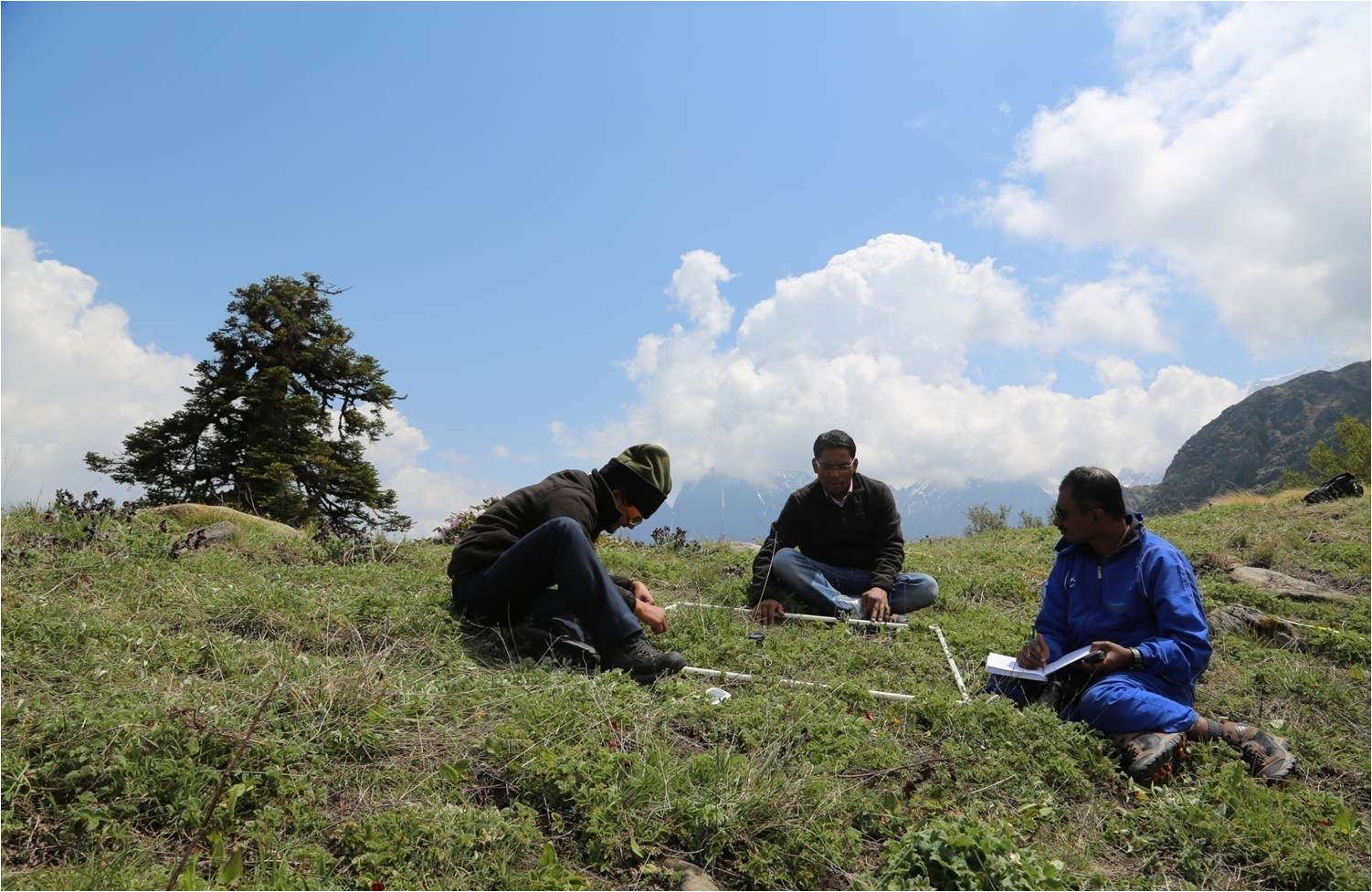
| • | Establishment of Long Term Monitoring (LTM) sites for Biodiversity Assessment (All IHR States): 595 plots (581 Floral and 14 Faunal) . | ||
| • | Database on Himalayan Flora/Fauna (All IHR States): >47000 Species Collection; 30000 species documentation; >100 GIS MAPs; passport data catalogue for 745 accessions of 39 indigenous crops of Uttarakhand; genetic database of identified 58 species i.e. Orthopotera (11 spp. ) Hymenoptera (31 spp.), Arachnida (3 spp.) Amphibia (6 spp.) and Reptiles (7 spp.) | ||
| • | Developed 12 Germplasm Repository Site (>6.0 Ha) for conservation and sustainable use of threatened high value MPs at High altitude (>2600 m asl) | ||
| • | High altitude Medicinal Plant nursery (2.0 Ha) at 3200 m asl capacity more than 10.0 lakh seedling of MPs | ||
| • | Developed four-tier (Top, middle, lower and underground) conservation models for improvement of shifting cultivation in the farmers’ field (05 states of North eastern states). | ||
| • | Develop risk assessment tools and processes for identifying negative Human-Wildlife Interaction (HWC)-HP, UK, Sikkim and WB - Conflict intensity Maps; Density surface models for Leopard, Himalayan brown bear and Asiatic black bear & Predictive spatially-explicit species occurrence model | ||
| • | Develop and implement adaptive management strategies in some of the identified vulnerable areas (UK, West Bengal) - using Fox lights- Himachal Pradesh | ||
| • | Establishment of long-term fire monitoring plots- North Eastern States - 10 forest fire permanent monitoring plots- Mizoram. | ||
| • | Developed Long Term Monitoring protocol for selected indicator taxa in the Indian Himalayan Region. | ||
| • | Published a book on “Faunal Diversity of Indian Himalaya” | ||
| • | Published 28 researcher paper in National and Inter National Journal. | ||